Basics of Linear PerspectiveWhen we talk about one, two, or even three-point perspective, we’re talking about linear perspective. It’s a method of representing space in which the scale of an object diminishes as the distance from the viewer increases. Essentially, objects that are farther away from us appear smaller than those that are near. The position at which they meet at a horizon line (the intersection of where the ground meets the sky) is called the vanishing point.
Linear perspective might seem rudimentary but it wasn’t until the Renaissance that it had a name. In 1413, Italian architect Flippo Brunelleschi began developing linear perspective and the method that many artists use today. He started by painting the outlines of Florentine buildings in a mirror and saw that when the structure’s outline was continued, the lines ended on the horizon line.
Brunelleschi’s discovery was a major influence on artists at the time. Many years later, his friend Leon Battista Alberti penned De Pictura, the first treatise on linear perspective that explained how to correctly show distance in a painting using mathematic principles first proven by Euclid in ancient Greece.
Linear perspective might seem rudimentary but it wasn’t until the Renaissance that it had a name. In 1413, Italian architect Flippo Brunelleschi began developing linear perspective and the method that many artists use today. He started by painting the outlines of Florentine buildings in a mirror and saw that when the structure’s outline was continued, the lines ended on the horizon line.
Brunelleschi’s discovery was a major influence on artists at the time. Many years later, his friend Leon Battista Alberti penned De Pictura, the first treatise on linear perspective that explained how to correctly show distance in a painting using mathematic principles first proven by Euclid in ancient Greece.
|
|
|
|
ONE-POINT PERSPECTIVEOne of the best illustrations of single-point perspective is to imagine that you’re looking at a straight road. All of the elements of the composition—particularly the road itself—will converge at a single point on the horizon line. Single-point perspective can be at any point along the horizon line; the only stipulation is that all lines lead to the solitary point. Although elementary, it is evident in iconic works of art.
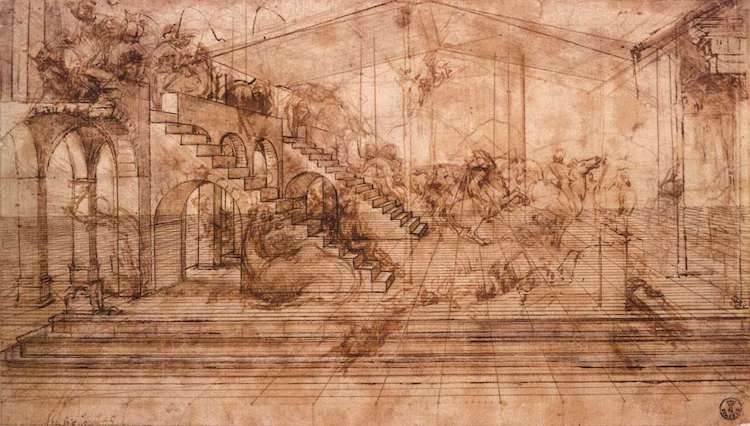
Leonardo da Vinci best exemplifies this in his perspectival study for The Adoration of the Magi around 1481 (above). This incredible sketch demonstrates the great lengths that da Vinci went through to determine the focal point of the piece. Notice how the lines, from the steps to the arches, all converge at the same spot on the horizon line. |

|
TWO-POINT PERSPECTIVE
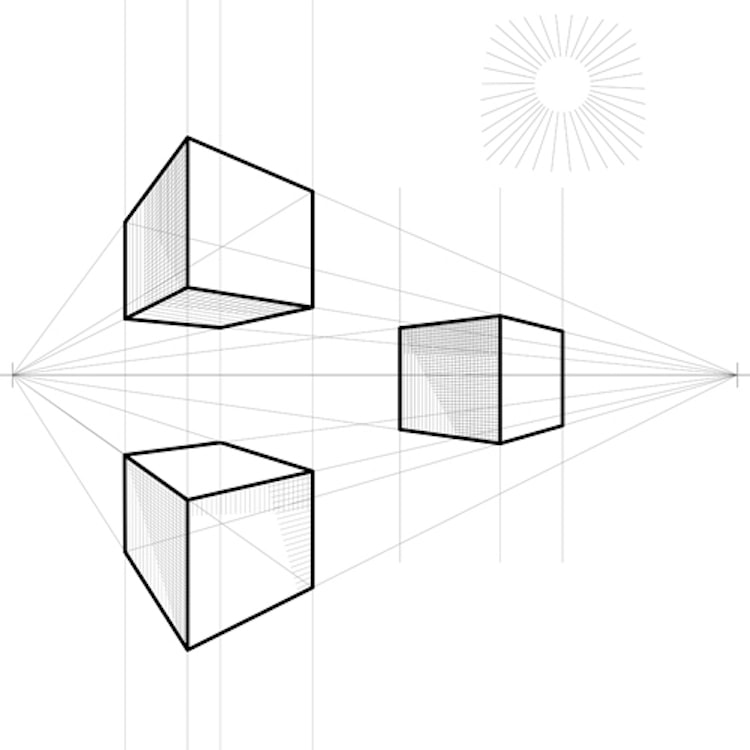
Just as one-point perspective focuses on one vanishing point, two-point perspective ushers in a second one. Typically, these two points are at the opposite sides of the composition, such as one on the far left and another on the far right.
Just as one-point perspective focuses on one vanishing point, two-point perspective ushers in a second one. Typically, these two points are at the opposite sides of the composition, such as one on the far left and another on the far right.
|
|
|
THREE-POINT PERSPECTIVE
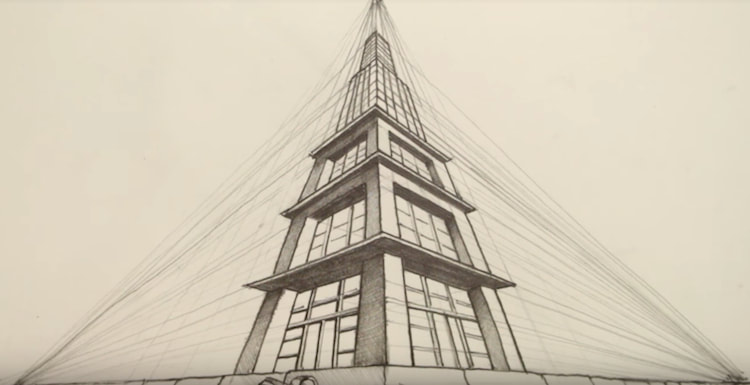
Three-point perspective, also called multi-point, is a type of perspective that has more than two vanishing points. This is common, especially as the complexity of the subject matter grows. A standard setup features two vanishing points on the far left and far right of the composition and then the third point below them. In doing this, you get a bird’s eye view to the subject. If you were to place the third point above the two vanishing points, it would create an extreme view looking upwards.
Three-point perspective, also called multi-point, is a type of perspective that has more than two vanishing points. This is common, especially as the complexity of the subject matter grows. A standard setup features two vanishing points on the far left and far right of the composition and then the third point below them. In doing this, you get a bird’s eye view to the subject. If you were to place the third point above the two vanishing points, it would create an extreme view looking upwards.
|
|
|
Additional Resources
|
|
|
|
THE FORMATIVE
THE SUMMATIVE
OPTION ONE - 1 point perspective: Circular City
MUST INCLUDE THE FOLLOWING
- imagine or use buildings that you have a personal connection to (use buildings you have toured or visited, use your home, places you wanted to visit, etc)
- Must be a minimum of a 8 inch circle if going inward and a 4inch if working outward
- all structures must be aligned to the vanishing point
- students will finish by using sharpie to add a darker value to create contrast, add value through shading or, finish with color pencil.
- Cut out circle and mat on black.
- work is refined, clean and well executed (without impurities, elegant, etc)
- The idea is unique and/or altered from any used reference image.
- Work is aesthetically pleasing and shows effort in rendering. There is apparent attention to detail
OPTION TWO - 2 Point: Perspective Surrealist Architecture
MUST INCLUDE THE FOLLOWING
- imagine a structure that expresses imaginative dreams and visions free from conscious rational control. BEYOND THE RELMS OF REALITY!
- Must be a minimum of a 9 inches in one direction
- all structures must be aligned to the vanishing points
- finish by using sharpie to add a darker value to create contrast, add value through shading or, finish with color pencil.
- work is refined, clean and well executed (without impurities, elegant, etc)
- The idea is unique and/or altered from any used reference image.
- Work is aesthetically pleasing and shows effort in rendering. There is apparent attention to detail
